
BIOTech Futures
Challenge Guidebook
A complete guide to the BIOTech Futures Challenge
What is BIOTech Futures?
BIOTech Futures is an innovation challenge that brings together high school students in teams of 2-5 with a mentor from either a university or industry background. Over six weeks, your mentor will guide you to explore shared areas of interest, identify a real-world problem, and develop a creative, research-driven solution. You'll apply scientific research, critical thinking, and engineering/scientific processes to bring your idea to life.
Your solution will be showcased in the submissions you provide, as outlined in the Deliverables section of this handbook.
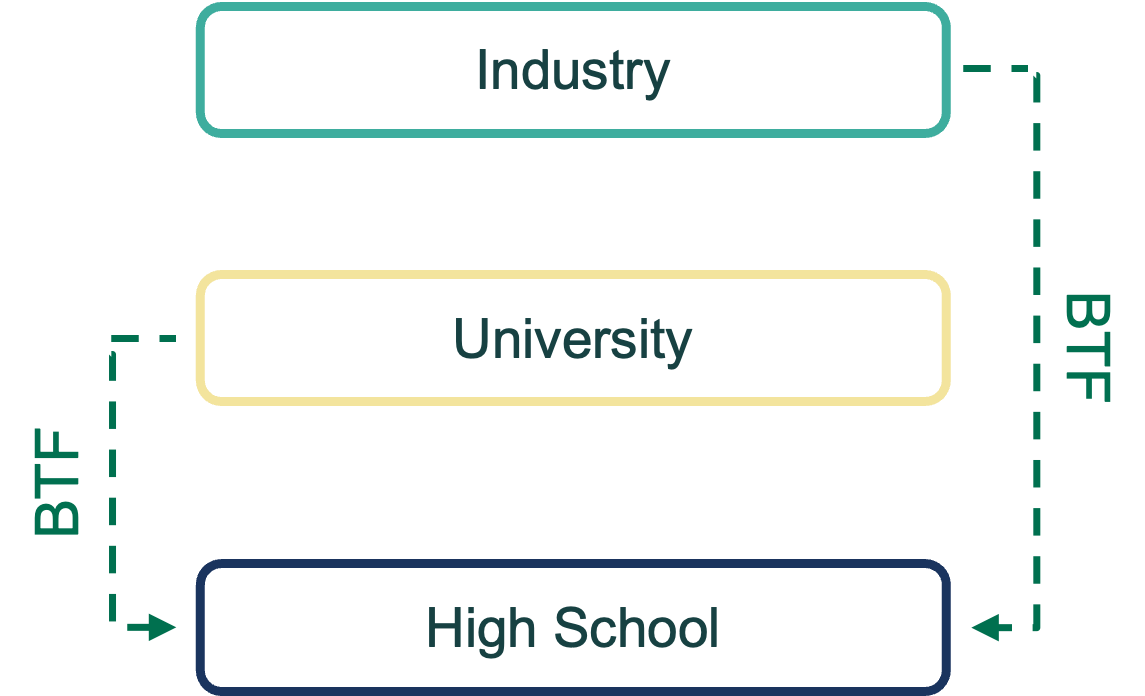
This guidebook is your go-to resource for understanding the challenge process, expectations, and where to find support along the way.
Good luck - we can't wait to see what you create!
What is 'innovation'?
Innovation is the creation of something new or different - an idea, process, or product that addresses a problem or improves on what already exists. It often begins with a desire to solve a challenge, and in science and engineering, researchers use their knowledge and skills to make these ideas a reality.
Australian researchers have a proud history of innovation, from groundbreaking medical devices like the cochlear implant and pacemaker, to ultrasound imaging, solar hot water systems, and impactful environmental campaigns such as Clean Up Australia and Earth Hour.
True innovation requires more than just a great idea. It demands resources - time, energy, funding, and mental resilience. Along the way, you may face setbacks, scrap your original plans, and start over multiple times. Successful innovators persevere, adapt to change, and remain committed to their vision until the very end. Remember: innovation is sparked by imagination, but it's realised through persistence and dedication.
The BIOTech Futures Challenge also recognises that bringing a scientific innovation to life depends on more than just the science. Ethical considerations, regulations, and economics all play a role, making an interdisciplinary approach essential for turning ideas into real-world impact.
What leads to effective innovation?
Successful innovation often comes from a mix of skills, mindsets, and approaches. By taking part in the BIOTech Futures Challenge, you'll have the opportunity to develop these essential skills and experience what it's like to think - and act - like an innovator.
- Background knowledge: A strong understanding of your field starts with research. Reviewing existing studies, inventions, and solutions helps you build a solid foundation for tackling the problem you've chosen.
- An interdisciplinary approach: Great ideas often come from crossing boundaries. Drawing on knowledge from different fields can inspire fresh perspectives and reveal new ways to solve your problem.
- Communication: Share your ideas and listen to others. Teammates, teachers, mentors, researchers, industry experts, and even your local community can all offer valuable insights to shape your solution.
- Stepping out of your comfort zone: Be open to exploring unconventional ideas. Not every approach will work - and that's okay. Mistakes are learning opportunities that help refine your thinking and move you closer to success.
- Testing: Once you have a potential solution, put it to the test. Depending on your project, this might involve experiments, prototypes, models, or simulations to see how your idea holds up in practice.
2025 Structure & Timeline
The details in this section apply to the NSW and International challenges. If you are participating in the QLD chapter, please refer to the dates in the QLD Guidebook. Winners and runners-up from the QLD chapter will be invited to present their work at the NSW Symposium - either in person or online.
Over the six-week challenge, you will investigate a real-world problem in either Medicine and Health, Sustainable Environment, or Emerging Technologies. You may also choose to explore a challenge related to the ethics, regulations, or economics of bringing an innovation to life. Your task is to develop an innovative solution - this could be a product or device, a treatment, a technique, or a method. The key is that it must directly address your chosen problem.
The challenge is designed to test your ability to research, analyse, and think critically, while encouraging creativity and problem-solving. It's also a chance to experience what working as a researcher is really like. Finalists, selected based on their submissions, will be invited to present their innovation and findings at the NSW Symposium, hosted at the University of Sydney on the 24th of October 2025. With a range of exciting prizes for the most outstanding innovations, this is your opportunity to showcase your ideas - and we wish you the best of luck!
Monday 4th August
Challenge Begins
Friday 19th September
Submissions Due
Monday 29th September
Finalists Announced
Friday 24th October
NSW Symposium
Friday 31st October
Challenge Marks Released
November
Prizes Distributed
Deliverables
To complete the Challenge, you must prepare:
- An A2 full-colour poster: You must use the official template.
- Short answer questions: Provided in the submission form.
- (Optional) A 1500-word report: Recommended to support your research and design process.
- (Optional) A prototype or model: Recommended to demonstrate your innovation in action.
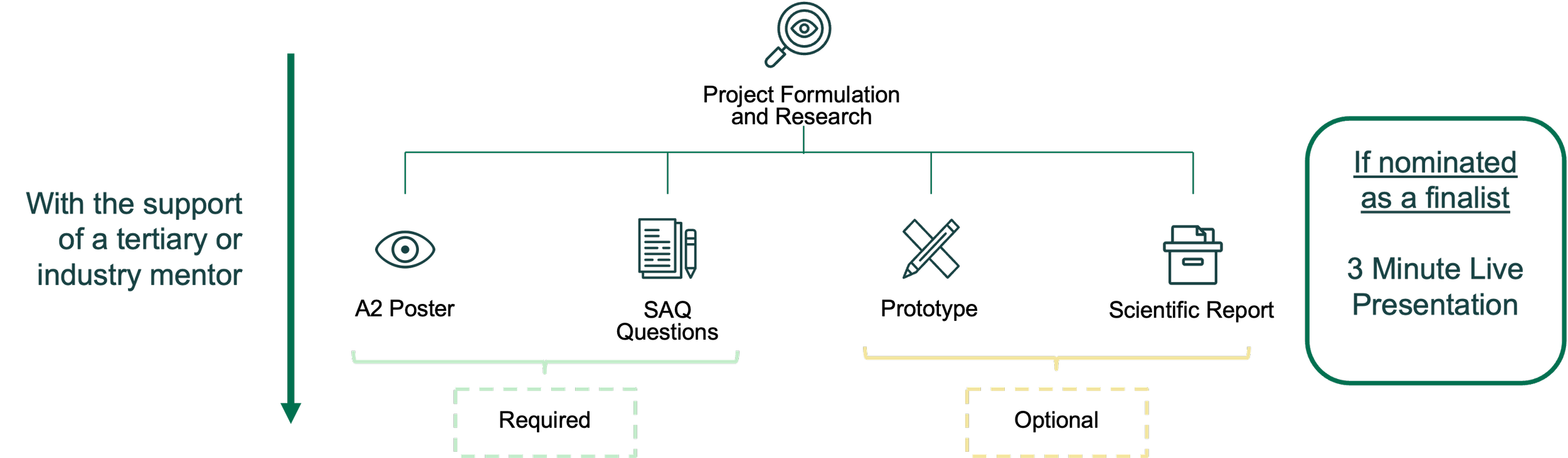
While the report and prototype/model are not compulsory, we highly encourage you to include them. They can deepen your understanding of your project, and make your innovation more compelling. Plus, there are separate prize categories for the best report and best model.
All required materials - your poster and short answer responses - along with any optional report and/or a photo of your prototype/model, must be submitted online via the BIOTech Futures submission portal by 19 September 2025.
A submission link and full instructions will be available on the BIOTech Futures website in the weeks leading up to the deadline.
Symposium
The BIOTech Futures Symposium is our day celebrating and showcasing all the incredible work you've done throughout the challenge. All participants, mentors, parents, and supervisors are warmly invited to attend.
The day will include:
- Finalist presentations: Hear from the top ~15 teams as they share their innovations.
- Science fair: Explore projects from every team and present your own with a 1-minute pitch.
- Guest speakers: Be inspired by leading engineers and scientists from around the world.
- Hands-on session: Get practical experience with the engineering design process.
- Awards ceremony: Recognising excellence based on finalist presentations, submissions, and science fair entries.
Mentorship
Mentorship is a key part of the BIOTech Futures Challenge - though it may be a new experience for some students. To help you get the most out of it, you'll find resources on how to be an effective student or mentor in the Resources section of our mentoring platform.
As a student, your mentor's role is to guide you through:
- Identifying a problem to tackle
- Formulating and refining your research
- Interpreting and applying research findings
- Providing feedback on your work
Our mentoring platform: Chronus
We use Chronus, an industry-leading mentoring platform, to support communication between groups. You can access it via this link.
Logging in:
- If you have a University of Sydney-provisioned UniKey, use the standard login.
- If you do not have a UniKey, most users, select the Alumni & External login option.
If you experience login issues, contact us at biotech.futures@sydney.edu.au.
Chronus features include:
- A Connection Plan outlining weekly milestones for your group
- Tools for scheduling meetings
- Access to shared resources
For a full overview of Chronus' features, visit this page.
Communication challenges
If you're a student and having trouble communicating with your mentor:
- Email biotech.futures@sydney.edu.au.
- We'll contact your mentor to resolve the issue.
- If we can't reach them within 48 hours, we'll reassign your team to a new mentor to minimise disruption.
If you're a mentor and having trouble communicating with your students:
- Check if your students' accounts are active on Chronus, via Group Details → each student's profile. Inactive profiles mean the parent/guardian permission form hasn't been signed, so the student cannot participate. In this case, email the supervisor to confirm participation - do not contact the student directly.
- If accounts are active, email the students and CC their supervisor. The supervisor can follow up in person.
- If there's still no response after a week, email biotech.futures@sydney.edu.au so we can close the group. If you'd like, we can assign you a new group.
The Research Process
Scientists, engineers, and academics across many disciplines follow a research process when developing innovations.
- Build background knowledge – The process begins by gaining a solid understanding of the chosen field. This includes reviewing current products or solutions, identifying existing challenges, and understanding the context in which the innovation will be developed.
- Formulate a research question – From this background research, the innovator identifies a specific problem to address. This often takes the form of an idea or concept that has the potential to solve one or more of the challenges discovered in step one.
- Test and refine the idea – Evidence is gathered to determine whether the idea can effectively address the problem. This stage follows an iterative design process, where the concept is repeatedly tested, modified, and re-tested until the most suitable version emerges.
- Present the findings – Finally, the innovation and the supporting research are presented, explaining how the solution addresses the identified challenges. This often happens at conferences, exhibitions - or in your case, the BIOTech Futures Symposium.
Obtaining background knowledge
Before tackling a problem, you first need to understand the current state of your chosen field. Researchers do this by conducting a literature review - a structured summary of existing knowledge and research that provides essential background context.
How do I conduct a literature review?
Define what you need to know: Start by identifying what you and your audience should understand about the field. Begin with broad, general information before exploring more specific aspects that could help you solve your problem.
Narrow your focus
- Develop a specific research topic.
- List relevant keywords and phrases related to that topic.
- Use flowcharts or mind maps to connect related concepts.
Search methodically: With so much information available, it's easy to feel overwhelmed. A systematic approach will help:
- Search widely at first, then filter for relevance.
- Take detailed notes as you go.
- Be prepared to revise your research question if your findings point in a new direction.
Identify the most relevant material: Once you have a broad understanding, focus on the aspects that are most significant to your problem.
Example Literature Review Structures
Topic: Pacemakers for Growing Children
- Anatomy/biomechanics of the heart
- Clinical reasons for using a pacemaker, e.g., arrhythmia, weakened contractions
- Historical development of pacemakers
- Principles of guided growth and product development
Topic: Incorporating Environmental Economics into Microplastic Reduction
- Bioaccumulation and biomagnification of microplastics
- Biotechnologies for reducing marine microplastics
- Links between environmental economics and human health
- Cost–benefit analysis of marine microplastic reduction
Note: The structure of a literature review will vary depending on the project scope - even within the same field.
Where to Find Information
General resources:
- Magazines, e.g., Scientific American
- Textbooks, reputable news sources, TED Talks, YouTube educational channels, books
- Discussions with teachers or mentors
- Wikipedia, only for initial orientation - always confirm facts with other reliable sources
Specific resources:
- Peer-reviewed journals, conference proceedings
- Scientific search engines such as PubMed or Google Scholar
- Open-access journals, since many paid journals require subscriptions
Evaluating Resource Reliability
Ask yourself:
- Where was it published? Journals with a high impact factor are generally more reliable, search online for a journal's impact factor.
- When was it published? Older papers are fine for foundational knowledge, but fast-moving fields, e.g., tissue engineering, may require sources from the last few years.
- Has it been peer-reviewed? Are the authors credible? Is the article free from obvious bias?
Formulating a research question
Once you have a solid understanding of your field and the research already completed, the next step is to formulate a research question. This is the central problem your project will aim to address.
Step 1 – Identify Challenges and Gaps. Look for:
- Weaknesses or limitations in existing studies, products, or solutions.
- Missing information or unanswered questions in the field.
- Areas where current approaches could be improved.
Step 2 – Define the Requirements. Think about what a successful solution would need to achieve. Consider:
- Technical or scientific requirements.
- Practical limitations such as cost, time, and materials.
- Ethical or environmental factors.
Step 3 – Propose a Solution. Once you have:
- Identified the problem and,
- Understood the requirements
You can start designing a potential solution. This will form the basis of your research question, which should be:
- Specific enough to be addressed within the scope of your project.
- Grounded in evidence from your literature review.
- Open to investigation, testing, and improvement.
"There is a significant need for <your idea> because of <the challenges in the field>. This project will primarily focus on developing an innovative design for <your design concept> to address <the core problem motivating the project>."
Carrying out the research
Now comes the fun part - designing your innovation and testing it! Every great researcher knows you must prove your idea works before it can solve a problem. While we don't expect you to conduct original experiments, though you're welcome to, you will need to clearly explain how your idea works and provide evidence supporting its effectiveness.
The Design Process
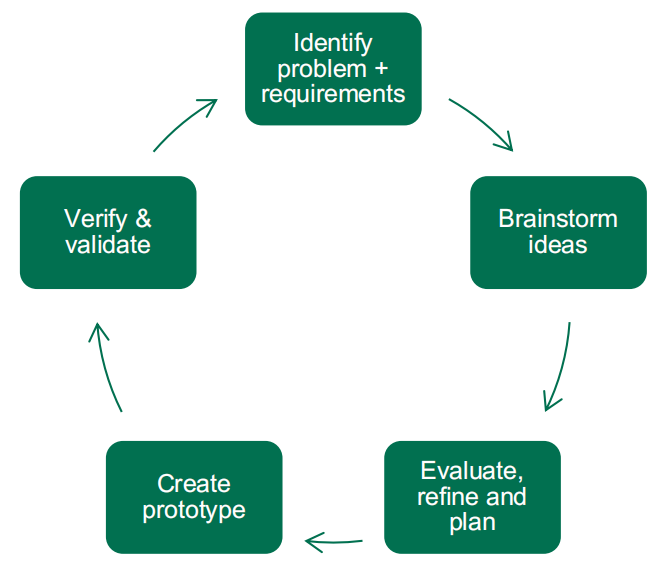
Designing your innovative solution will be the core of your project. This process involves continuous research, idea generation, testing, and refinement until you develop a solution that meets your requirements.
Here are the key stages:
- Identify the problem and requirements: Dig deeper into your defined problem. Who is your solution for? Are there contextual constraints or limitations? What must your design accomplish? Clearly specify the needs and criteria your solution must meet.
- Brainstorm ideas: Using your research, start brainstorming possible designs. You can adapt existing technologies, combine elements from different concepts, or even propose entirely new and creative ideas.
- Evaluate, refine, and plan: Review all your ideas and select the most promising one. Refine it by checking it against your defined needs and requirements. Plan your next steps to develop this solution further.
- Create a prototype, if possible: Build a model or representation of your design. Test it to see how it performs.
- Verify and validate: Test whether your solution meets all requirements and works effectively for your target users and context.
Throughout the design process, keep revisiting and improving your solution. If it doesn't fully meet the requirements, ask yourself:
- Can it be improved?
- Does it need to be redesigned?
- Or should you consider a different approach altogether?
Presenting your findings
Once you've developed a solution that meets all your project requirements, it's time to share your work! In the world of research, this usually happens at conferences or exhibitions, where researchers present talks, display posters, or showcase prototypes.
This is exactly what our BIOTech Futures Symposium is designed to emulate.
Poster & Short Answer Questions
During the Symposium, you'll share your innovative solution with fellow students, university academics, and biotech industry professionals through a science fair–style poster display.
Posters are a powerful way to present your research concisely yet with enough detail to tell the full story. As the saying goes, a picture is worth a thousand words! Creating a poster also tests how well you understand your own project, since fitting the entire scope onto a single page is a challenge.
Your poster should:
- Showcase your solution and explain how it addresses a problem in your chosen field.
- Reflect the research you conducted to understand the problem.
- Walk the reader through your design process.
- Clearly convey how your solution meets the necessary requirements.
- Explain why your chosen design is the best way to solve the problem.
Poster Requirements
Please use the official template provided to create your poster. While there's flexibility in formatting, your poster must include:
- Project title
- Team code
- BIOTech Futures logo
- Your school's logo
- Names of all participants, including mentors and academic advisors
- Affiliated schools or institutions of all participants, including mentors and academic advisors
- Contact details for a nominated team representative
Short Answer Questions
Alongside your poster, your submission will include short answer questions designed to complement your poster. These allow you to provide more detailed explanations without overcrowding your poster. This part of the challenge mirrors real-world research practices and university expectations. We strongly recommend working on these questions throughout the challenge, rather than leaving them until the last minute!
The questions you'll answer, up to 150 words each, are:
- What does your solution do?
- What inspired your idea?
- How does your solution work?
- Describe your design process.
- How is your solution different from existing ones?
- What are your future plans for your innovation?
Be concise and clear - 150 words is enough to be descriptive without losing focus.
Presentation (Live)
Finalist teams will be required to present a 3-minute presentation which showcases their research and solution.
Presentation Guidelines
Your presentation will follow the 3-Minute Thesis, 3MT, format:
- Maximum length: 3 minutes
- Presentations must be spoken word only, no songs, poems, or other formats
- You may use up to three PowerPoint slides, excluding the title slide
- Ensure you reference any figures or data that are not your own
Your presentation must include the following information at least once, this can be on a title slide:
- Project title
- Names of all participants, including mentors and academic advisors, along with their affiliated schools/institutions
- Team code
At least two members must participate in the presentation.
What should go in your presentation?
Make sure to cover these key points:
- Explain why your innovation is needed
- Identify your target market - who will benefit from your solution?
- Describe how your innovation works
- Highlight how your innovation is better than existing solutions
What makes a good presentation?
At its core, a great presentation is about clear and engaging communication. Here are some tips to help you prepare:
- Use audience-appropriate language: Avoid heavy jargon. Most listeners will be your peers who may not know much about your topic.
- Have clear take-home messages: What are the main points you want your audience to remember?
- Keep it simple: Use short words and sentences. Remember, there's no pause or rewind for your listeners!
- Engage your audience: Rhetorical questions, stories, or light humour can make your talk more relatable - but don't stray off-topic.
- Show enthusiasm: If you're excited about your project, your audience will be too! Think about how you'd feel watching your own presentation - would you be interested?
- Practice, practice, PRACTICE: Rehearse to build confidence, refine your timing and delivery, and reduce nerves. Practice helps with pacing, vocal variety, body language, and stage presence.
For more help preparing your presentation, check out these useful guides:
Report
Submitting a scientific report is optional, but strongly encouraged. There is a separate prize category for the best reports. Your report should provide a detailed account of the research and design process behind your solution. It consists of two main parts as below.
Literature Review
This should cover the research you completed in the first two steps of the Research Process. Refer back to the relevant guidebook section or consult your mentor for tips on writing a strong literature review.
Logbook
Your logbook records your entire Design Process, including data and analyses related to your design and testing. It should include:
- At least three design concepts, including your final solution
- An analysis of each design, explaining how it addresses the problem and why you chose your final design-referencing your literature review to justify your decision
- An analysis of methods and materials planned for your product, if applicable
If your project includes a prototype, your logbook can also include:
- Materials and methods used to build the prototype
- An analysis of what the prototype reveals about your design
If you conducted any firsthand experiments, include:
- Aim and hypothesis
- Methods and materials
- Results
- Discussion
If relevant, you may reference previous studies and data to support your design assumptions or concepts. When discussing your design, prototype, or investigations, always explain how your final solution meets the problem's needs and to what extent it succeeds.
Tips for writing up your logbook:
- Document everything: Include meeting notes, brainstorms, even 'dead-end' ideas. Often, what seems irrelevant can spark a breakthrough!
- Be detailed: Small observations may be crucial to solving your problem.
- Label figures and tables clearly: So they make sense independently from the text.
- Be concise: Provide enough detail without being overly wordy.
Ask yourself:
- Does it make sense when read aloud?
- Can all team members understand the content?
- Could I read this six months later and still understand it?
Structure & Formatting
Your report should include:
- Cover page: project title, specific and engaging, team/student names
- Abstract: a concise summary of your report, one paragraph
- Acknowledgements: including mentors
- Table of contents
- List of figures, tables, and abbreviations
- Literature review
- Logbook
- Challenges and Future Work: summarize what remains to be done and potential issues in production or distribution
- Conclusion
- References
- Appendices
Formatting:
- Word limit: 1500 words, includes literature review, logbook, challenges/future work, and conclusion
- Font: Times New Roman, size 12
- Margins: 2.54 cm, standard
Academic Integrity
As a BIOTech Futures participant, you must uphold academic integrity. Always acknowledge work that is not your own - this shows respect for the scientific community and strengthens your research's credibility.
Referencing
Support every claim that is not general knowledge with an in-text reference. This shows your research is evidence-based and helps others verify your work.
e.g. "Numerous studies have reported excellent mechanical properties for hydroxyapatite-based scaffolds, with compressive strengths ranging from 5–20 GPa [1], though decreases over time have been observed [2–5]."
At the end of your report, include a bibliography or reference list in a consistent style, e.g., APA, MLA, Harvard, Chicago. You may use any referencing style as long as you apply it consistently throughout. You must also include references in your poster and presentation slides.
Resources that may help you with referencing:
- Cite This For Me: automatic citation generator, double-check accuracy
- EndNote: professional reference management software, if available
Academic Dishonesty & Plagiarism
Academic dishonesty includes any attempt to gain unfair advantage, and plagiarism will result in immediate disqualification from the Challenge.
Examples include:
- Copying text without attribution
- Slightly changing copied text without citation
- Using others' media without permission or credit
- Submitting someone else's work as your own
- Buying or commissioning work online
- Translating content without citing the original source
Always ensure your work is original or properly referenced.
Contact
BIOTech Futures International